Their comment revealed only mild disappointment as they approached the desk at the Visitor Center and said, "We just hiked to The Chimneys but never found the cave paintings." I went to the Book Store shelf in the next room and showed them the color plate of the petroglyphs carved into the rock face about nine feet above the main trail. I added an explanation that it was unlikely that the 'artists' used ladders or scaffolding to reach so far up but that the trail had been eroded away in the thousand or so years since the etching was made.
Drawings by archaic people are not all 'cave paintings.' There are such drawings here in the American Southwest, usually on the walls of rock shelters, like those in the near-by Seminole Canyon State Park. As common, or even more so, are petroglyphs. These are not drawings or paintings but a kind of pointillist art achieved by chipping at a flat stone surface to peck away dots of the rock's patina to make figures of creatures or geometric shapes appear. Some of the creature depictions are recognizable but more often the shapes and forms are lost like the language and beliefs of the Ancient Ones.
The Chimneys is an igneous rock outcropping, the result of volcanic activity millions of years ago. The rock prominences are more like phallic towers than womb-like shelters. So no 'cave art.' Had the young couple spent more time letting the landscape reveal itself, they might have seen the rock engravings. They went expecting to find what was not there and then did not discover what was.
It is not how far you go that makes a hike, it is how you go far that makes one.
Thursday, December 19, 2013

Saturday, November 30, 2013
Totally self-serving
OK, so what I have to say in this post has no meaning beyond patting us on the back. Having said that up front, let me get on with it.
Yesterday a fellow with an accent that was obviously not learned in West Texas came into the Visitor Center. He wanted a 'back-country permit' that would allow him to use the River and maybe camp along the Santa Canyon (on the US side). He seemed to be aware of rules and regulations about using the River and back-country camping. So, taking his $10 fee, I issued him the permit. Only then did he tell me that he wanted to fish in the River as well. So, instead of issuing an additional piece of paper, a non-fee fishing permit, I simply hand-annotated his permit as a 'license' allowing him to fish wherever he wanted.
Today, Thomas, returned to show me the photo of the large carp he had fished out of the Rio Grande, and then wise to the health of the River, released it. I told him that had he not produced a picture I would have doubted his veracity as few if any 'fisherman' end up catching anything.
He and his family had returned to the Visitor Center to be a part of the audience for my demonstration about making an adobe brick. Altogether, there were 27, about equally split between adults and children who spent 45 minutes at the demonstration, my helpers were the kids. Having children there is always a real hi for me and I so do my best Mr. Rogers impersonation, sans sweater.
In minutes the kids were up to their elbows in clay, water and horse poop to hand-mix and knead the mud mixture into the consistency of biscuit dough. Once again, with all the kids crowded around the wheelbarrow, I had only to do the final kneading and mixing and placing the globs of mud into the mold. Thus, again with breath to spare, I could address the adult audience with bon mots about sun-dried brick making and the linguistic origin of the word 'adobe.'
On the way down the hill to view the oldest adobe building in the Park, The Alvino House, one of the boys, Leon, said something that made me guess that his mother tongue was not English but German. When I asked him, in German, if he could speak that language, he responded, "Ja, das kann ich sprechen. (Yeah, I can speak that.) Thus I learned that his father's accent, while only scant, was Teutonic.
When we came back up the hill from viewing the oldest adobe house, Leon and his brother, Jonas, wanted to help me clean up the wheelbarrow and the mud mess. While taking their time with the clean-up, they fashioned a few tiny 'bricks' and made a miniature mud house.
When they were finally finished, they brought me their completed workbooks, with what they had learned about the Park, to qualify them to receive a Jr. Ranger badge and embroidered patch. Their Dad, Thomas, told me that they had about a dozen such badges and patches from other National Parks in the Southwest.
So when I 'swore them in' as Jr. Rangers, I didn't ask them to take the printed 'Jr. Ranger Pledge' on the back of their workbook. I said to them, "You have already taken the Jr. Ranger pledge a dozen times, so I am asking you to take a unique Ranger pledge, auf Deutsch, in German. Then I asked them to raise their right hands and repeat after me: Fuer meine Mama und Papa, ich verspreche ein hilfreiches Ranger zu sein. (For my Mom and Dad, I promise to be a helpful Ranger.)
A video was recorded by their Mom and their Dad said, 'If they deny that they have promised this, we will have it to show them.'
As I turned to go back into the Visitor Center, the Dad pulled me aside and said, "We have not introduced ourselves. My name is Thomas and my wife is Sandra. I am an officer in the German Air Force, serving duty in El Paso. See that truck over there. I bought it when we came here three years ago. We use it only for our vacations. I have driven it more than 45,000 miles to nearly all the National Parks in the west of the USA. We take all our vacations to visit the National Parks. Are you going to be here next year at this time?" "We'll, we haven't decided," I replied, "my memory is not as good as it once was in answering visitor questions." "You must return," he said, " in all the Parks we have visited, we have never met a couple like you and your wife." He extended his hand and gave me a sincere handshake. He then went into the Visitor Center so that he could personally say, "Auf wiedersehen," to Jane.
Just when both of us thought our time had about run out ...
Travelers and Nomads
Last week it was the couple from Russia who appeared to qualify as 'having traveled the farthest' to visit Big Bend National Park. This Thanksgiving Day-Weekend it was the six guys from Hong Kong who agreed with me that there were very few deserts in Hong Kong.
Before I continue, let me remind you that Thanksgiving weekend is one of the three busiest of the year, competing with Christmas-New Year, and outdone only by 'Spring Break.' During the latter two weeks, all the schools in Texas are 'on break' at the same time and it is difficult to find a place to lay down a sleeping bag in the entire Park.
On a typical day, we have 16-30 visitors in the Visitor Center here on the far West side of the Park. We like to say that we are not the end of the world, but you can see it from here. Thanksgiving Day there were 75 visitors. Yesterday, Black Friday in the rest of North America, 121 people chose marveling in the wonder of a National Park to contributing to the tyranny of Capitalism and the Wal*Mart embarrassment. By the way, I don't think that the Waltons are monsters, but then Adolph Eichmann was not either. Think 'the banality of evil,' as in the description by Hannah Arendt.
But, back to visitors. The honors for recognition, since I am the Master of Ceremonies at this moment of awards, goes to Josh and Lindsey and their four children, ages 2, 4, 6, and 8. Daddy, Josh, is a teacher and Mommy, Lindsey, is one too but she dedicates her abilities to home-schooling.
They owned a house but were having trouble paying off the mortgage and the student debt, so they sold the house to concentrate on becoming free of the school loans. For nearly two years they have lived in a tent; 'as big as this room' said the eight-year old, telling me about their life and indicating our Visitor Center. Daddy goes to his teaching job from a nearby State Park where their tent is pitched. When they have stayed the limit allowed campers in one park, the pack all their belongings into the Dodge caravan and re-establish a new home.
While Mommy sat catching up on some self-time, reading alone in the richly upholstered chair in our Book Store, Daddy sat on the similarly cushy sofa there, piled upon by his kids, reading kids' book after kids' book from our bookshelves. The children learned that 'Josephina Javelina' isn't a pig but is a 'collared peccary' and doesn't like being referred to as a pig. They liked the 'Who Pooped in the Park' book too, a favorite of kids and quite informative about scat and tracks on the trails. "Lizards for Lunch' introduced them to the appearance and appetite of the Greater Roadrunner, who probably cannot outrun Wiley Coyote, but that makes for a good cartoon.
Having brought two little boys on a whirlwind camping fortnight to the Southwest in the early 1970s, Jane and I were somewhat awestruck by this semi-nomadic family. Their commitment to the well-being and education of their children was exemplary. Their dedication to being debt-free was both remarkable and enviable. May such tribes of nomads increase!
Monday, November 25, 2013
It's been a quiet week ...
It's been a quiet week in Lake Woebegone Big Bend National Park. Visitors are moping in to the Visitor Center, hanging around a lot more, looking at the historical display information, asking more questions. But a gloom hangs over it all. No one seems to be really enjoying themselves.
One of the most frequent questions is, "We were told that November is an excellent time to visit the Park; is this weather unusual? How long will it last?" When I respond, "Two days ago, when I clicked on the weather on the Internet here, it indicated that we had 0% change of precipitation, but the visitors to whom I gave that answer frowned when they walked out to the parking lot in rain," they look at me like I'm some kind of incompetent. They then say, "You're a volunteer, aren't you!"
Well, yes I am, but the honest-to-God Rangers as well as the volunteers with more experience than we have haven't the slightest hint of more expertise than we have on this subject.
What was going on when we arrived in late October in a light rain has only gotten more so. Yes, September and October are the wet months in the southwest Texas desert, but rain on in to November is a real exception. A week ago it was 98 degrees on the Visitor Center porch, but Saturday of this week, it was a drippy and dreary 37 degrees.
I usually grin from ear to ear when I tell folks that we come down here because this is the best place to spend a winter in Ohio. Some of the charm has been washed off that cleverness. In fact, when it was so cold and wet on Saturday, I cancelled the adobe demonstration, not that anyone would have shown up in any event, but in case one or two did, I had no intention of mixing horse manure, clay and cold water, by hand, and blathering on about 'green construction' in arid climates in a hoddie and fleece jacket.
We spent yesterday, Sunday, running around the apartment, cozy in our slippers and sweats, reading a bit, napping and lazily working on the transcription of an oral history interview. The Oral History Project is what we are to spend one day each week working on, but we don't sit for eight hours at a time listening and transcribing. We dribble the task out to relieve the tedium of it.
One of the busiest times in the Park is Thanksgiving weekend, so after these few days off, the rest of the week will probably not be so quiet. Since we are scheduled to work in the Visitor Center each Thursday, Friday and Saturday, this year none of the holidays are leisure times for us. Thanksgiving Evening, the Ranger who coordinates volunteers is hosting dinner for all of us. She plans to bake the bird and the rest of us will bring the sides-dishes and desserts.
It has nothing to do with anything but as I typed that last word in that previous sentence, I remembered that 'stressed' spelled backward is 'desserts.'
Hope y'all have a pleasant Thanksgiving!
PS-
Electricity just went off as I'm finishing this blog. Will have to publish it later this afternoon. It is not unusual to lose power for short periods- winds I guess play heck with power lines.
Thursday, November 21, 2013
Surveillance of the Surveillers
Although the NSA probably already knows it, from monitoring my emails, I haven't told you about my assignment for today, if I choose to accept it. (Since the assignment did not come on a self-destructive recording, but in an email, I have time to consider it and the mission is not impossible.) The Park Archaeologist needs photos of the housing units built for the Border Patrol agents who live around the corner from our apartment.
The Archaeologist does not usually monitor such recent human habitations as housing units constructed only a year or so ago. But whenever changes to any structure are proposed anywhere in the Park, the Archaeologist needs to weigh-in with an opinion.
It seems that the Border Patrol wants to replace the rather attractive cedar board fences, already in place, with some kind of steel wire-mesh and rock enclosures. Apparently the BP housing units at Presidio, Texas, have already been re-fenced. I suppose that in a hot-spot like the Ojinaga, Mexico - Presidio, Texas crossing, there might be a possibility of shots being fired at BP residences, but truth be told, BP agents here seem to have to invent ways to keep busy.
A BP agent did die here in the Park a year or so ago, but his death was caused from a fall into an arroyo when he was carrying equipment for monitoring that caused him to lose his balance. In other words, while he did die in the line of duty, it was more of an industrial accident than one would expect from being in harm's way.
So before we take off to appear like we are just going to work at the Visitor Center, I'll snap a few clandestine pics of Homeland Security buildings. My hunch is that the Archaeologist will make his recommendations based upon his aesthetic sensitivities rather than any sense that our neighbors need additional protection.
Unless there have been instances of BP housing units coming under fire, my best hunch is that this is one more piece of evidence that the Department of Homeland Security has several pork barrels of money they do not know what to do with. I have a suggestion: there are folks who could use some help with re-financing their homes due to Federal and other malfeasance long before we need to spend any money on re-fencing remotely located houses.
I'll let you know if I get one of those letters telling me to cease and desist this kind of cyber-chatter. No, wait, if I get one of those letters, I'll be prohibited from letting anyone know, yikes!
Wednesday, November 20, 2013
Good to have you back!
Alpine, Texas, 110 miles north of the Park, was today's destination. It is an altogether pleasant drive. The trip is through desert, past a couple of bentonite mines, Kokernot Mesa, Elephant Mountain Wildlife Management Area and a moment's stop at the Border Patrol road-block 10 miles out of Alpine. After verbally assuring the young BP officer that we were indeed US citizens and learning from him that he was from Port Clinton, Ohio, and had attended Ohio State, we proceeded to Brewster County's Seat.
As an aside, to save you going to Wikipedia, bentonite is an absorbent aluminium phyllosilicate, essentially impure clay consisting mostly of montmorillonite. The absorbent clay was given the name bentonite by Wilbur C. Knight in 1898, after the Cretaceous Benton Shale near Rock River, Wyoming. There are different types of bentonite, each named after the respective dominant element, such as potassium (K), sodium (Na), calcium (Ca), and aluminium (Al). Experts debate a number of nomenclatorial problems with the classification of bentonite clays. Bentonite usually forms from weathering of volcanic ash, most often in the presence of water. However, the term bentonite, as well as a similar clay called tonstein, has been used to describe clay beds of uncertain origin. For industrial purposes, two main classes of bentonite exist: sodium and calcium bentonite. It is used for drilling mud, as an absorbent, as a water barrier, in cosmetics and for medicinal compositions.
We arrived, as we had notified her by phone, to take Celestine Amatulli out for lunch at her favorite place, La Casita, a very popular Mexican restaurant, not one of many in a chain, of course. 'Chele' as she is known by family and friends, is the daughter, now in her 80s, of the town constable, Feliz Valenzuela, who was gunned down by a Sotol smuggler in Terlingua, Texas, in 1938. We had recorded her oral history and copies of numerous family documents and photos two years ago and she's been one of our best Texas friends since. The pollo y queso quesadillas (chicken and cheese quesadillas) were excellent and the perfect lunch.
After lunch, our next stop was at the Ace Hardware to purchase a 'Swiffer' and its wet/dry components to serve to keep the apartment relatively Texas-dust free. We bought a tortilla press as well so that we can continue to get better at making our own corn tortillas. Jane wanted the Swiffer stuff; I was interested in the 'Tortilladoro.'
Porter's Safeway is across the street from the Hardware. An hour or so and two carts later, we had enough victuals to stock the pantry and fill the fridg and its freezer compartment to last a couple of weeks.
About half-way through the checkout, a man's voice from behind me, at the next checkout lane, said, "You are back, I see." I turned to see who the voice was and said to a total stranger, "Yes, back at the Park; it's the best way that we know to spend a winter in Ohio." He smiled and said, "Good to have you back."
In the truck on the two-hour drive back from the grocery run, Jane said she thought she had seen the fellow in the Visitor Center, but his was an anonymous face so far as I was concerned.
Both Jane and I have been asked just why we have returned year after year to this remote Park in southwest Texas desert, to give thirty-two hours each week for three months, for no more compensation than a place to park our trailer or, this year, an apartment unused, except by mice, spiders and scorpions for months before we arrive.
I think I just said why.
Monday, November 18, 2013
House Slippers on the Dresser
But I thought house slippers went on the floor right beside the bed. Well, they do usually. We've decided though that it is better to place your bare feel on the floor, after carefully looking at where they are to be placed. Then one can reach the slippers from off the dresser and not have to worry about crowding a scorpion with your toes.
We had not given that strategy all that much thought until the other evening. As she walked in the dimly lit hallway to the bedroom, Jane started to reach down to pick up a dust ball. The dust ball picked itself up, curled its tail menacingly arched up over its back and scampered under the closet door.
When I moved the bag in the closet that contains our small hand-sweeper, the scorpion, about three inches long if its tail were to be stretched out, was on the wall just above the base-board. A swat only knocked it to the closet floor where it retreated into a crack too narrow for its escape, I mistakenly thought.
So, in addition to this apartment being a Mouse Motel, it is also a Scorpion Sanctuary. That latter status is afforded the creatures only because they move fast and can squeeze into the tiniest places.
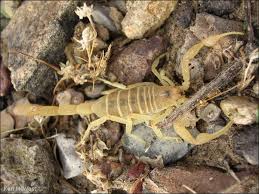
Scorpions are predatory arthropod animals of the order Scorpiones within the class Arachnida. They have eight legs and are easily recognized by the pair of grasping claws and the narrow, segmented tail, often carried in a characteristic forward curve over the back, ending with a venomous stinger. Scorpions range in size from 3.5 in (Typhlochactas mitchelli) to 7.5 in (Hadogenes troglodytes). Our Texas variety, The Striped Bark Scorpion (Centruriodes vittatus) gets to be about 3.5 inches as an adult. If I can get to a little one on the floor in our apartment, I try to prevent its maturity.
The little rascals are nocturnal, hiding in cracks and under stuff in the sunlight, to avoid whatever might find them tasty. They do have an unusual characteristic though. They glow in the dark! Well, at least if you shine an ultra-violet light, like a black-light, on them, they appear fluorescent greenish in color. As is apparent in the picture above, not ours, it's from Google Images, one of these could look like a dust ball in dim light. Our fellow volunteer, Bob, left his hand-held black-light at the Visitor Center, so I'll bring it home today to scan the dark corners of our habitat.
Scorpions of our Texas variety prey on small insects, even tiny lizards and such but can ingest food only in a liquid form; they have external digestion. The digestive juices from the gut are egested onto the food and the digested food sucked in liquid form. Any solid indigestible matter (fur, exoskeleton, etc.) is trapped by tiny hairs in the pre-oral cavity, which is ejected by the scorpion. In that they consume only liquid food, they resemble the scruffy, guitar-playin' ole boys we see on the porch at the trading post in Terlingua (our nearest town). Those guys don't have any apparent stingers but most of their nutrient comes in liquid form from tall brown bottles and aluminum cans with labels like "Lone Star" and "Tecata."
I have to admit that I have a characteristic or two in common with scorpions. They can consume huge amounts of food at one sitting. They have a very efficient food storage organ and a very low metabolic rate combined with a relatively inactive lifestyle. Unlike me though, this enables scorpions to survive long periods when deprived of food; some are able to survive 6 to 12 months of starvation. Also unlike me, if you'll excuse an excursus into bowel habits, scorpions excrete very little; their waste consists mostly of insoluble nitrogenous compounds such as xanthine, guanine and uric acid.
Interesting as all this may be and as fascinated as you've been learning about these arachnids, I think you'll agree that the fall infestation of Asian Lady-Bugs in Ohio is much preferable to having slippers on the dresser and scorpions on the floor.
We had not given that strategy all that much thought until the other evening. As she walked in the dimly lit hallway to the bedroom, Jane started to reach down to pick up a dust ball. The dust ball picked itself up, curled its tail menacingly arched up over its back and scampered under the closet door.
When I moved the bag in the closet that contains our small hand-sweeper, the scorpion, about three inches long if its tail were to be stretched out, was on the wall just above the base-board. A swat only knocked it to the closet floor where it retreated into a crack too narrow for its escape, I mistakenly thought.
So, in addition to this apartment being a Mouse Motel, it is also a Scorpion Sanctuary. That latter status is afforded the creatures only because they move fast and can squeeze into the tiniest places.
Scorpions are predatory arthropod animals of the order Scorpiones within the class Arachnida. They have eight legs and are easily recognized by the pair of grasping claws and the narrow, segmented tail, often carried in a characteristic forward curve over the back, ending with a venomous stinger. Scorpions range in size from 3.5 in (Typhlochactas mitchelli) to 7.5 in (Hadogenes troglodytes). Our Texas variety, The Striped Bark Scorpion (Centruriodes vittatus) gets to be about 3.5 inches as an adult. If I can get to a little one on the floor in our apartment, I try to prevent its maturity.
The little rascals are nocturnal, hiding in cracks and under stuff in the sunlight, to avoid whatever might find them tasty. They do have an unusual characteristic though. They glow in the dark! Well, at least if you shine an ultra-violet light, like a black-light, on them, they appear fluorescent greenish in color. As is apparent in the picture above, not ours, it's from Google Images, one of these could look like a dust ball in dim light. Our fellow volunteer, Bob, left his hand-held black-light at the Visitor Center, so I'll bring it home today to scan the dark corners of our habitat.
Scorpions of our Texas variety prey on small insects, even tiny lizards and such but can ingest food only in a liquid form; they have external digestion. The digestive juices from the gut are egested onto the food and the digested food sucked in liquid form. Any solid indigestible matter (fur, exoskeleton, etc.) is trapped by tiny hairs in the pre-oral cavity, which is ejected by the scorpion. In that they consume only liquid food, they resemble the scruffy, guitar-playin' ole boys we see on the porch at the trading post in Terlingua (our nearest town). Those guys don't have any apparent stingers but most of their nutrient comes in liquid form from tall brown bottles and aluminum cans with labels like "Lone Star" and "Tecata."
I have to admit that I have a characteristic or two in common with scorpions. They can consume huge amounts of food at one sitting. They have a very efficient food storage organ and a very low metabolic rate combined with a relatively inactive lifestyle. Unlike me though, this enables scorpions to survive long periods when deprived of food; some are able to survive 6 to 12 months of starvation. Also unlike me, if you'll excuse an excursus into bowel habits, scorpions excrete very little; their waste consists mostly of insoluble nitrogenous compounds such as xanthine, guanine and uric acid.
Interesting as all this may be and as fascinated as you've been learning about these arachnids, I think you'll agree that the fall infestation of Asian Lady-Bugs in Ohio is much preferable to having slippers on the dresser and scorpions on the floor.
Subscribe to:
Posts (Atom)